Carles Alemán, Marc Arnau and Jordi Sans: “Hydroxyapatite can cease to be just a support and become an active catalyst against CO₂”
Feb 27, 2026
A team of researchers from the IMEM-BRT group at UPC explain, in an interview with Interempresas, how the greenhouse gas catalyst they have developed works and what applications it has. The catalyst, made from a material abundant in nature, has received the 15th UPC Award for Research Valorization, with the collaboration of Fractus, within the framework of the Fractus-UPC Deep Tech Hub.
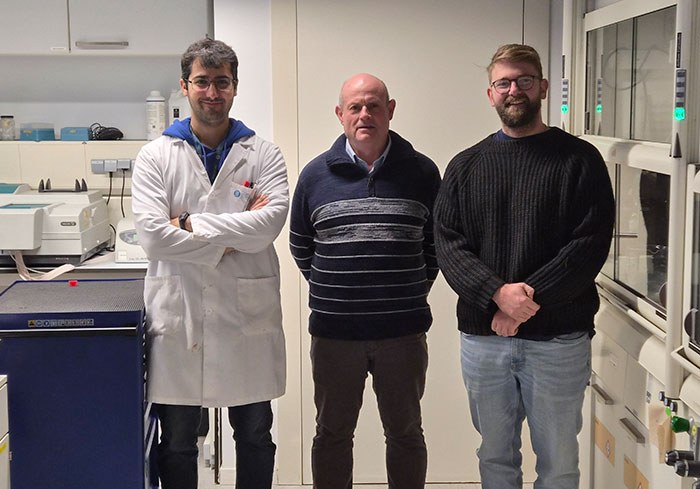
Transforming carbon dioxide from industrial emissions into valuable chemical products without resorting to noble metals is one of the major challenges in modern chemistry, as these materials are expensive and scarce. Carles Alemán, Marc Arnau and Jordi Sans, researchers from the IMEM-BRT group at the Universitat Politècnica de Catalunya - BarcelonaTech (UPC), have developed a catalyst based on hydroxyapatite, a bioceramic material present in our bones, that overcomes this challenge and does so with similar efficiency and at a lower cost.
The catalyst developed by IMEM-BRT makes it possible to transform carbon dioxide into valuable products such as alcohol or urea, and it is designed so that companies generating large CO₂ emissions can implement it. In this way, they will not only be able to reduce emissions but also reuse them.
Share: