Researchers design a catalyst to produce industrial chemicals from greenhouse gases
Dec 09, 2025
A UPC team has developed a ceramic, biocompatible catalyst that captures greenhouse gases and converts them into useful chemicals in a more sustainable and cost-effective way than current technologies. The technology has won the 15th UPC Research Valorisation Award, organised by the Board of Trustees with the support of Fractus and the Fractus UPC Deep Tech Hub, as the best market-ready invention.
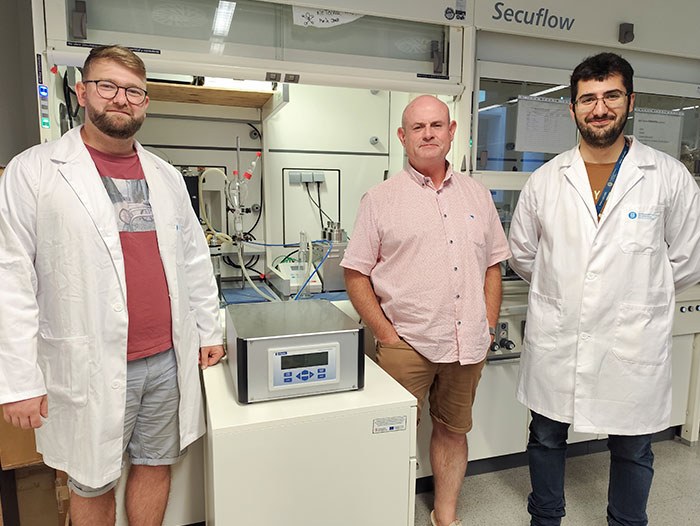
Researchers from the Innovation in Materials and Molecular Engineering - Biomaterials for Regenerative Therapies (IMEM-BRT) research group at the Universitat Politècnica de Catalunya - BarcelonaTech (UPC), in collaboration with the R&D team at B. Braun Surgical, have developed a technology based on permanently polarised hydroxyapatite, a ceramic and biocompatible material that acts as a catalyst. Its main innovation lies in capturing greenhouse gases such as carbon dioxide (CO₂) and transforming them into useful chemicals in a more sustainable and cost-efficient way than existing technologies.
Reducing emissions is both an academic challenge and a social necessity. Jordi Sans, researcher from IMEM-BRT explains that this technology “can transform how companies manage gaseous waste, enabling them to reduce their carbon footprint while generating economic value.”
Share: